What we set out to build
A fully autonomous badminton-playing robot that can sustain a reliable rally against a human opponent.
- report
The goal
The goal of this two-year project is to design and build a fully autonomous badminton-playing robot capable of sustaining a reliable rally against a human opponent.
This project is self-proposed (meaning the Engineering Physics Project Lab has chosen to sponsor us), with a 2-year timeline. The team was motivated by the success of previous interactive, multidisciplinary engineering projects, such as the RL air hockey agent, and the desire to tackle a complex, high-speed tracking challenge.
Scope
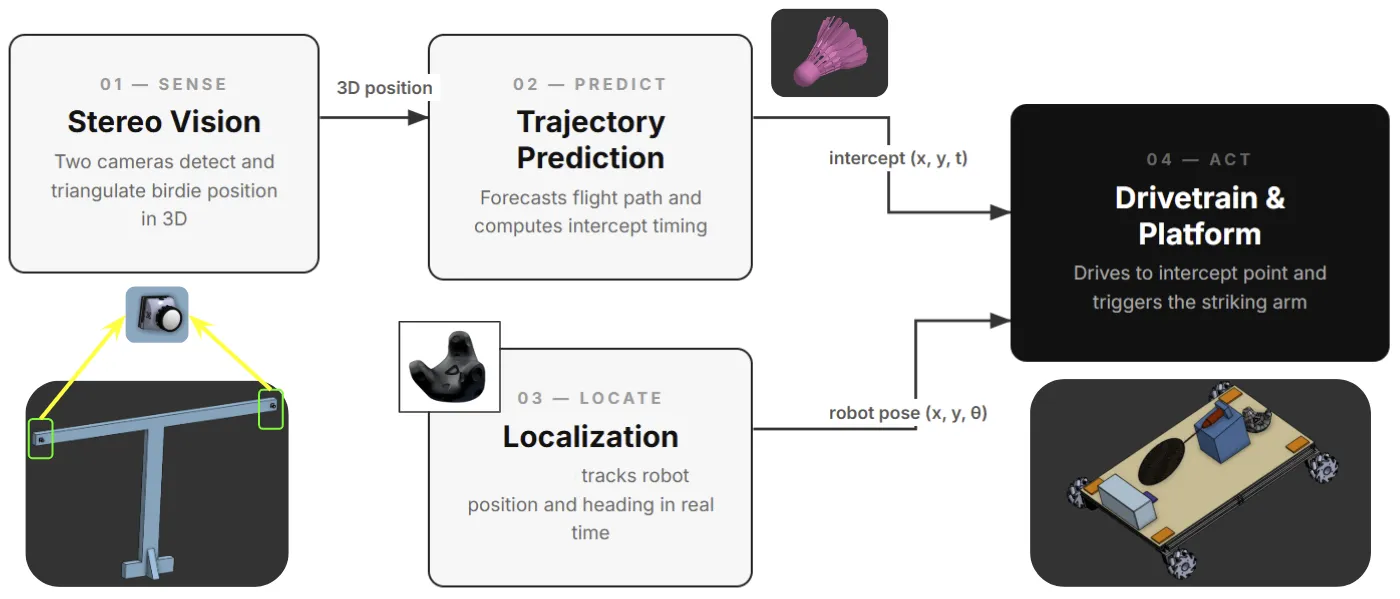
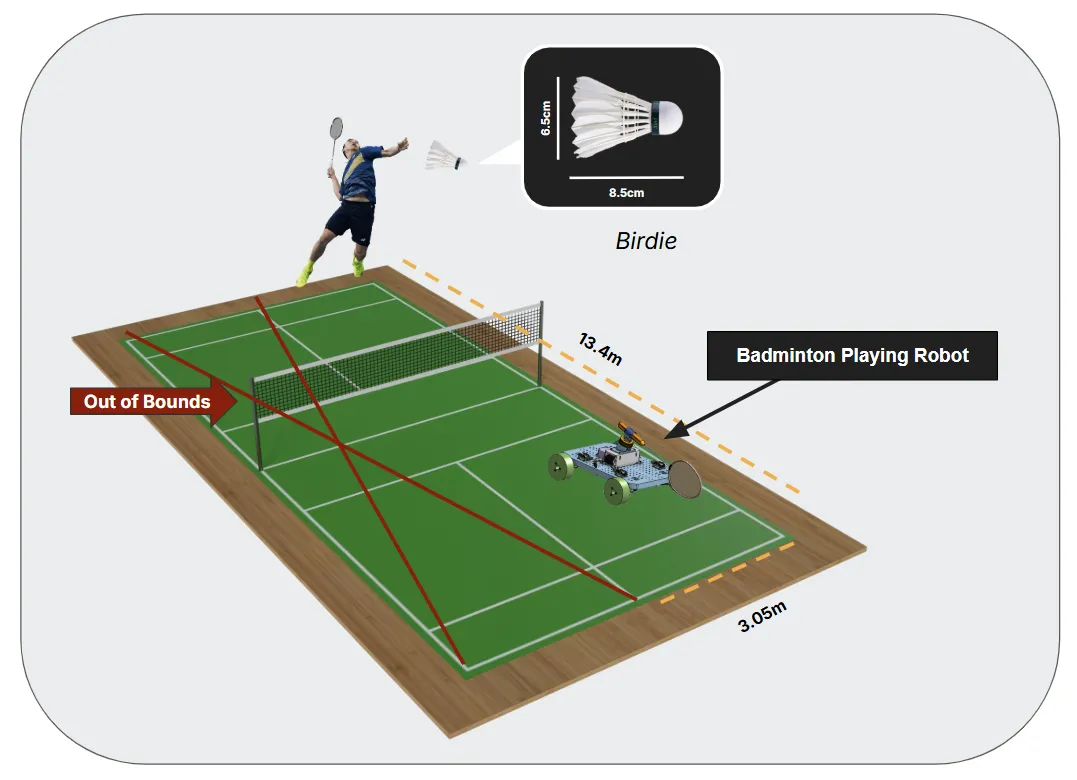
The project requires tracking the birdie and robot in 3D space, predicting trajectories, moving rapidly and returning the birdie using a striking arm. The robot must execute these tasks quickly to strike the birdie in time, meaning typically under 2 seconds.
To make sure the April 2027 completion deadline is met, the operational scope is focused on returning standard rallies. Advanced manoeuvres, such as high-velocity smashes, are out of scope. The constraints are a half-court region and gentle rallying.
Three systems
We divided the fully autonomous system into three sub-challenges for the year:
- The physical chassis. Designing the mechanical drivetrain and electronic architecture to be capable of rapid court movements and striking to return birdies.
- Trajectory prediction. Developing a highly accurate computer vision and tracking system, using algorithms such as an Extended Kalman Filter (EKF), to predict shuttlecock flight paths in real time.
- Robot localization. Implementing a robust localization system to ensure the robot knows its position relative to the court.