Logbook

Badminton Robot

A fully autonomous badminton-playing robot. Custom stereo vision, an Extended Kalman Filter for prediction, and a mecanum drivetrain, built to sustain a rally against a human opponent.

6 entries

  1. October 2026
  2. Saving our vision system from the depths

    Background subtraction saved our project.

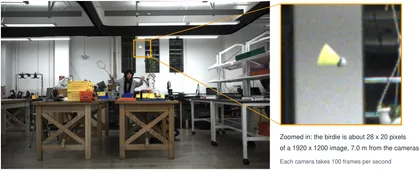
    • One frame from the left camera, the full 1920 by 1200 frame, with the birdie about 7 m from the cameras
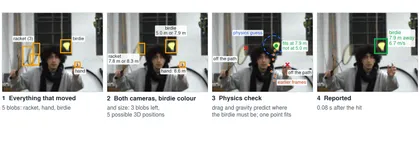
    • Four steps: everything that moved, both cameras and birdie colour, the physics check, and the report 0.08 s after the hit
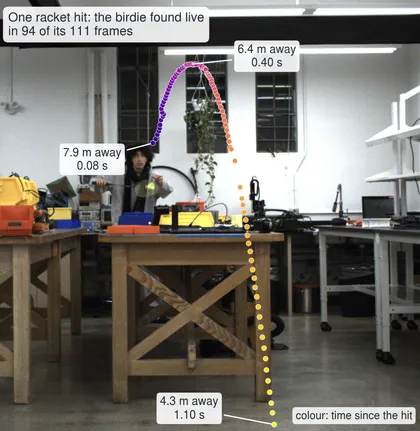
    • One racket hit: the birdie found live in 94 of its 111 frames, coloured by time since the hit
    • vision
  3. Entries lost to time

    hard to keep a log when things are moving so fast...

    Apr 12 to Oct 2, 2026
  4. April 2026
  5. Year 1, where we ended up

    The vision and prediction pipeline is the year's primary achievement. Detection is unsolved, the motors came late, and the HTC Vive did not work out.

    • report
  6. The robot

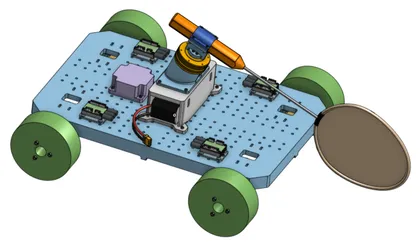
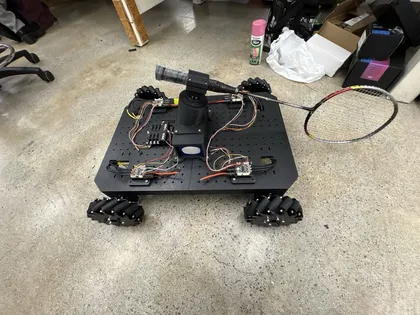
    Four mecanum wheels, a one degree of freedom striking arm (for now), a mostly 3D printed chassis and an all off-the-shelf 24V electrical system.

    • The robot CAD, with the striking arm, power distribution block, drive motor ESC, battery, racquet and mecanum wheels
    • The full robot assembly, without motors
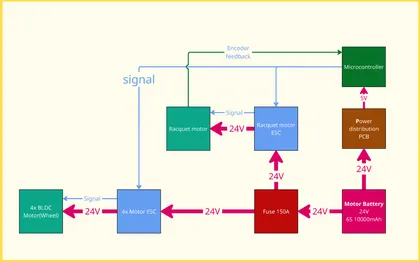
    • The electrical system: the battery feeds a fuse and power distribution, then the drive motor ESC and the racquet motor ESC, with encoder feedback to the microcontroller
    • report
    • hardware
  7. Predicting where the birdie lands

    Drag and gravity, an Extended Kalman Filter, and a Runge-Kutta forward simulation turn a stream of 3D positions into a landing spot and a time-to-arrival.

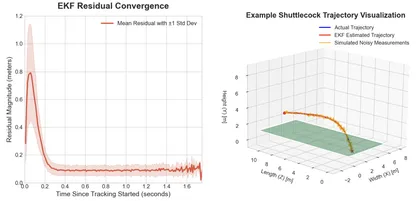
    • Tracker error against time, and the EKF tracking simulated noisy measurement data
    • report
    • prediction
  8. Stereo vision and detection

    Two cameras triangulate the birdie's 3D position in real time. The geometry works, but picking the birdie out of a dark image does not.

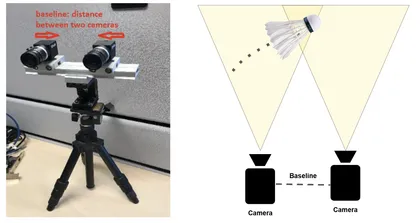
    • Left: an example physical stereo vision setup. Right: the stereo vision setup diagram
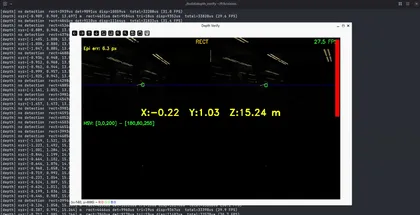
    • The depth verify tool showing live stereo triangulation output, validated to 15 m. The low exposure makes the image nearly black.
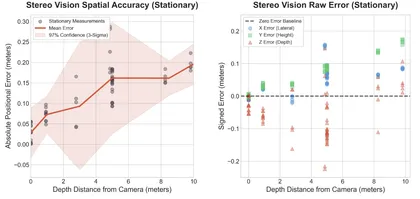
    • Stereo vision characterization results: spatial accuracy against depth distance from the camera, and the signed X, Y and Z error
    • report
    • vision
  9. Entries lost to time

    hard to keep a log when things are moving so fast...

    Sep 2 to Apr 9, 2026
  10. September 2025
  11. What we set out to build

    A fully autonomous badminton-playing robot that can sustain a reliable rally against a human opponent.

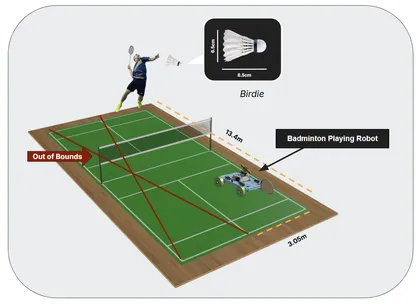
    • The robot on a badminton court, with the birdie dimensions and the out of bounds line
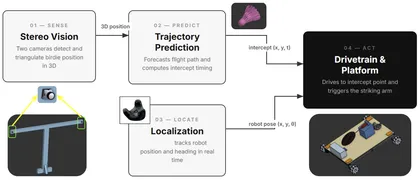
    • The three key subsystems: stereo vision senses, trajectory prediction predicts, and the drivetrain and platform acts, with localization tracking the robot
    • report