The robot
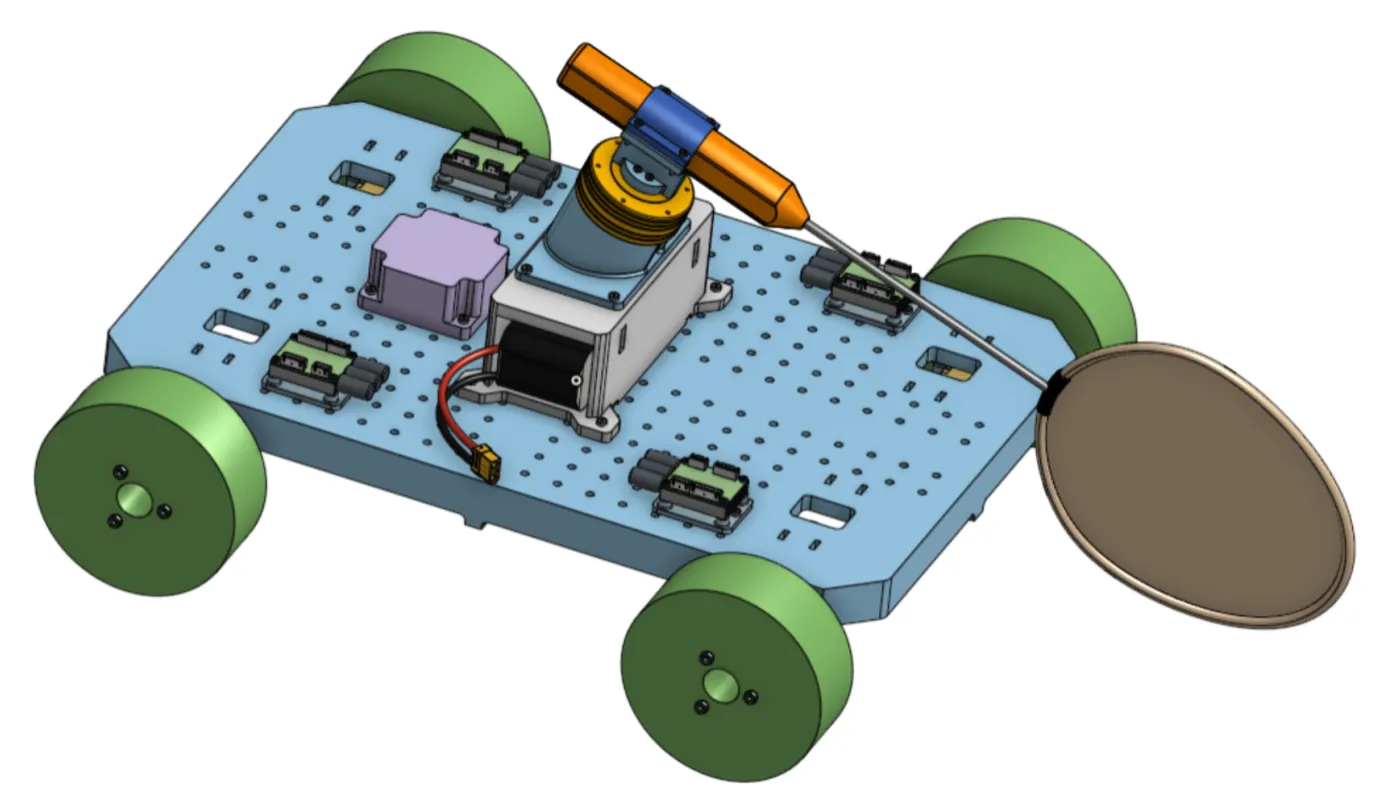
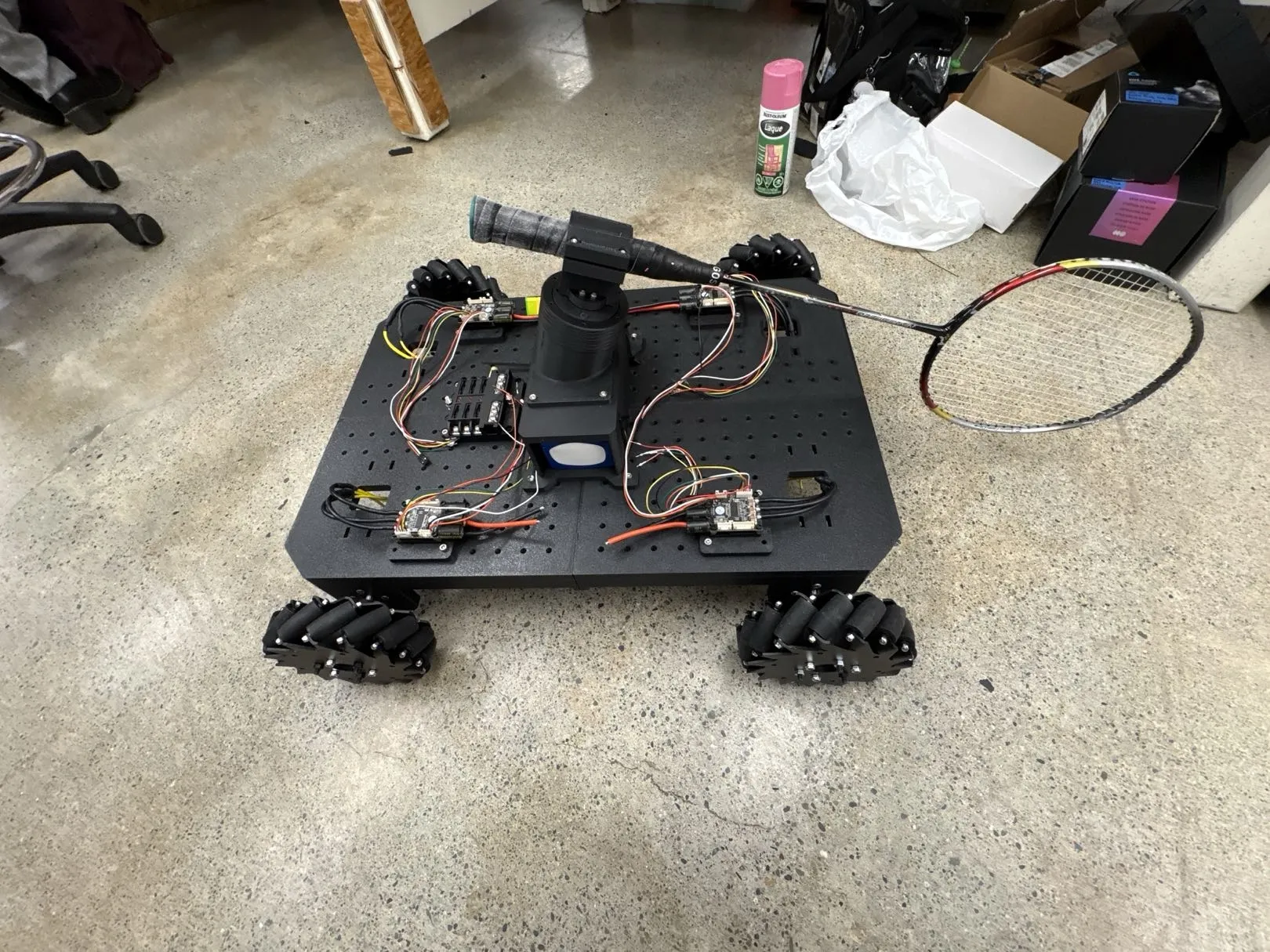
Four mecanum wheels, a one degree of freedom striking arm (for now), a mostly 3D printed chassis and an all off-the-shelf 24V electrical system.
- report
- hardware
What the robot has to do
We want the physical robot to traverse to the corners from the centre within 2.5 seconds from the moment the birdie is struck. That distance is roughly 3.7 metres, giving us a max speed and acceleration requirement of 2.95 m/s and 2.36 m/s² (assuming a triangular acceleration profile).
Given the racquet as the end effector, the striking arm needs to be swung at approximately 400 RPM at birdie contact to enable a shot reaching the far extremes of the court. These criteria drive the robot’s weight budget and motor selection.
Drivetrain
The drivetrain is responsible for moving the robot to the predicted birdie landing location within the allotted time. The design consists of four individually driven 6-inch mecanum wheels mounted at the 4 corners of the robot, which allows for omnidirectional motion through differential steering. This reduces weight and complexity. It also reduces travel time.
We chose the motor and gearbox system based on the requirements above, which translates to output shaft requirements of 2.1 Nm at 650 RPM, with an estimated robot weight of 18 kg. Maxon BLDC motors (6100 RPM at 0.285 Nm, nominal) combined with a 10:1 planetary gearbox were selected due to their high power density and compact size, while satisfying the RPM and torque requirements under continuous operation.
Striking arm
The striking arm sits above the chassis and actuates once the robot is at the predicted landing location and the birdie reaches the striking height. The arm consists of a badminton racquet clamped to the striking motor, installed at a 25-degree angle to the floor (subject to change in the future). The arm has 1 degree of rotational freedom around a tilted vertical axis, which only enables an upwards return shot called a lift.
Although simple, lifts are more versatile and can be used against all types of shots, whereas other methods of returning (like smashes) can only strike the birdie at a specific height and angle. This is intentional, to keep the scope of the project viable, as adding multiple DOF for more complex striking options will deeply complicate the mechanical and electrical design.
Given the 90 kg·cm² moment of inertia of a badminton racquet, the motor output needs to be 4.4 Nm at 400 RPM. A CubeMars robotic motor (4.5 Nm at 450 RPM) with a built-in encoder was chosen for its integrated controller and gearbox. This motor meets our striking criteria and allows for precise positional feedback and control, which is essential for controlling the birdie’s outgoing direction.
Prototyping and manufacturing
With a footprint of 40 by 60 centimetres, the majority of the robot is 3D printed for ease of fabrication and fast prototyping. It also allowed more complex geometries than other prototyping methods, such as laser-cut and water jet, while being more accessible and affordable than CNC machining.
PLA is used as the main material due to availability, ease of printing, and high print quality. Parts under high cyclic load and/or temperature, such as wheel hubs and motor mounts, were printed out of PPA-CF, which has much higher stiffness and glass transition temperature. The chassis is printed in four pieces and bolted together due to the print bed size of the available printers. Patterned holes sized for threaded inserts are left throughout the chassis.
Electrical system
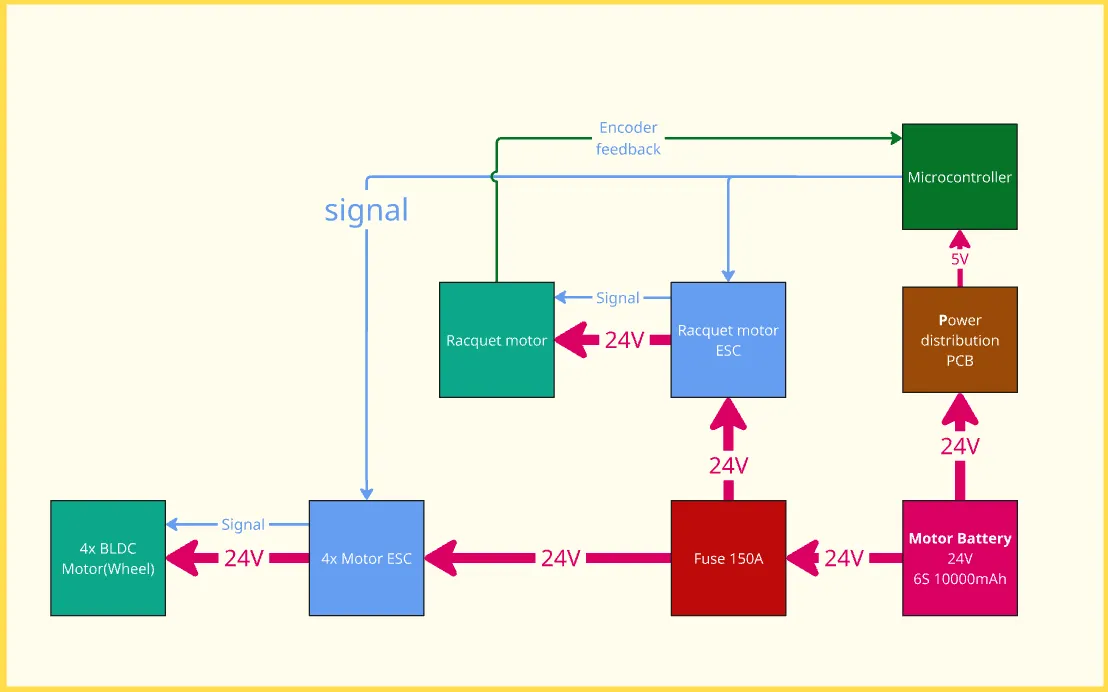
All electronics on this robot are off-the-shelf to eliminate potential risks in designing custom PCBs. The robot runs on a 24V architecture. A 6S, 12C, 10000 mAh LiPo battery powers all electronics, enabling 20+ minutes of continuous play. Power distribution to motors is done through a 6-way power distribution block with integrated fuses, and each individual drive motor is controlled by a VESC. The striking motor has an integrated controller and encoder.