Scoping RL and mapping the arm's reach
Settled on approach iv (RL on top of IK+PD) as the starting scope. Mapped the Panda arm's reachable workspace from 300,000 sampled joint configurations and laid out a plan to get training running.
- decision
- experiment
What I’m trying to achieve
Pick the RL scope for the arm tracking pipeline and lay out the infrastructure needed to start training.
Thoughts
Picking the approach
Last session I mapped out four RL approaches:
| Name | Geometry solved by | Dynamics solved by | Difficulty | |
|---|---|---|---|---|
| iv | RL + IK + PD | IK | PD | trivial: RL only guides on top |
| iii | RL + PD | RL | PD | medium: RL discovers inverse kinematics |
| ii | IK + RL | IK | RL | medium: RL learns the torque/dynamics |
| i | RL end-to-end | RL | RL | hard: RL learns both |
Some questions going in:
- Is there a science for estimating training length per approach?
- Is approach iv actually trivial? Is it not impressive that the model learns feed-forward?
- Will training generalise to trajectories the model was not trained on?
Answering the questions above:
- No closed-form formula for RL sample complexity. It is all empirical, but there are reference benchmarks online.
- With fresh eyes: iv is the right starting point. The plumbing is reusable. Re-scope if time allows.
- Generalisation depends on the training distribution. Train only on circles and it will not handle lines.
Decision
All four approaches share the same reward (-||target − ee||). The only difference is the action space: a larger space makes credit assignment harder. Starting with iv keeps the problem tractable.
With fresh eyes, I have decided to start with iv, and expand scope if I have time. Seeing RL learn “feed-forward” would be very satisfying!
Plan
I plan on making four files. All flat in the home directory until the structure is clear:
trajectory.py: I’m going to need a random trajectory for each episode to train on. I’ll have to address generalisation in training directly.env.py: the Gymnasium environment. It’ll havereset()which picks a random trajectory and resets the stage,step(action)which allows the model to output its 3D Cartesian vector and run the whole IK + PD step afterwards. I’ll also declare the observation space and action space here.train.py: I’ll set up the SB3 PPO, vectorised envs, and save the policyeval.py: where we watch what the current policy is up to, and compare it to the classical approach I already built!
Once these four are stable, I’ll refactor components into /core.
Experiment
Chunk 1: Deps
uv add stable-baselines3 gymnasiumGymnasium is an environment interface. It’s just what allows us to separate RL from MuJoCo.
SB3 is the library of algorithms. It has PPO ready to go for us. It also pulls in torch which is the neural-net backend we need to run PPO.
And of course, uv add not pip install as we’re using pyproject.toml and uv.lock to keep my deps reproducible for when I deliver the project.
Chunk 2: trajectory.py
To write this file, I’ll need to understand the shape of the Panda’s maximum reach. To do this, I’m going to sample hundreds of thousands of different angles across all 7 joints, and see where the arm ends up.
See verify_length.py in the GitHub.
samples: 300000 (15.0s)
reach  min/mean/max : 0.013 / 0.768 / 1.190 m

max reach by cone (within ~45 deg):
  +x fwd  : 1.057 m   -x back : 1.051 m
  +y left : 1.058 m   -y right: 1.060 m
  +z up   : 1.190 m   -z down : 0.458 m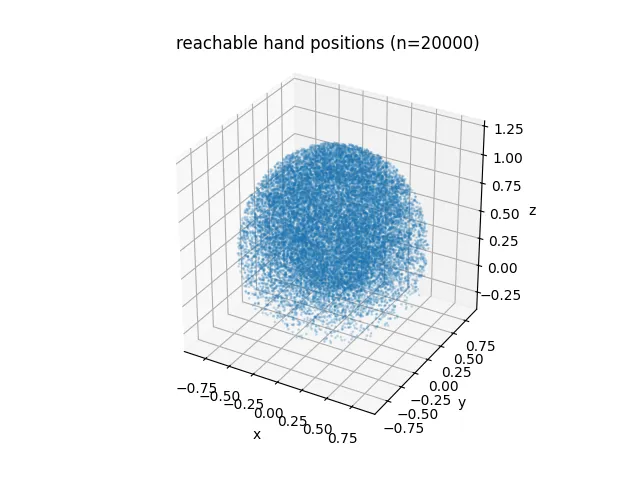
The reachable volume is nearly a sphere, truncated below the base.
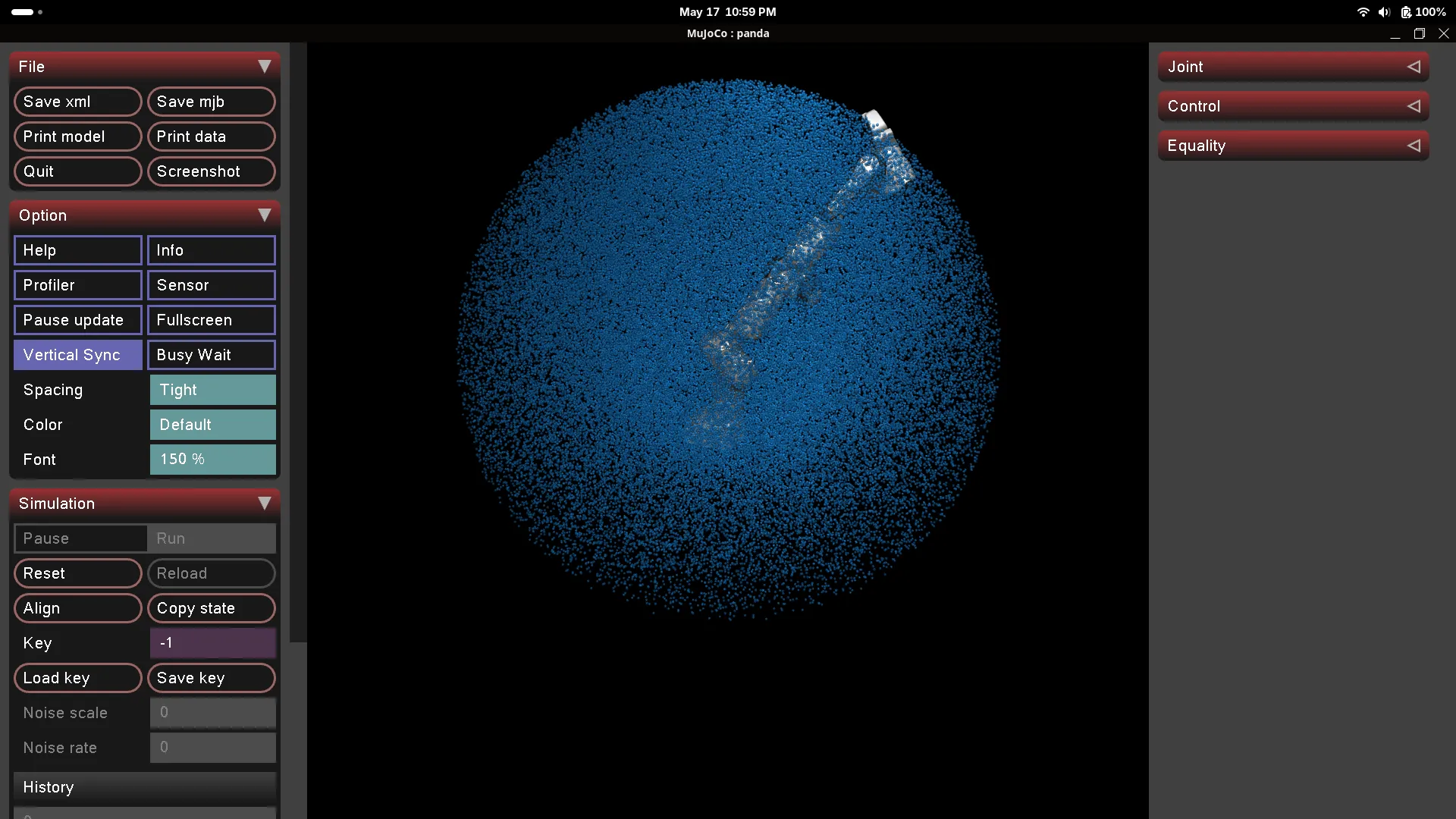
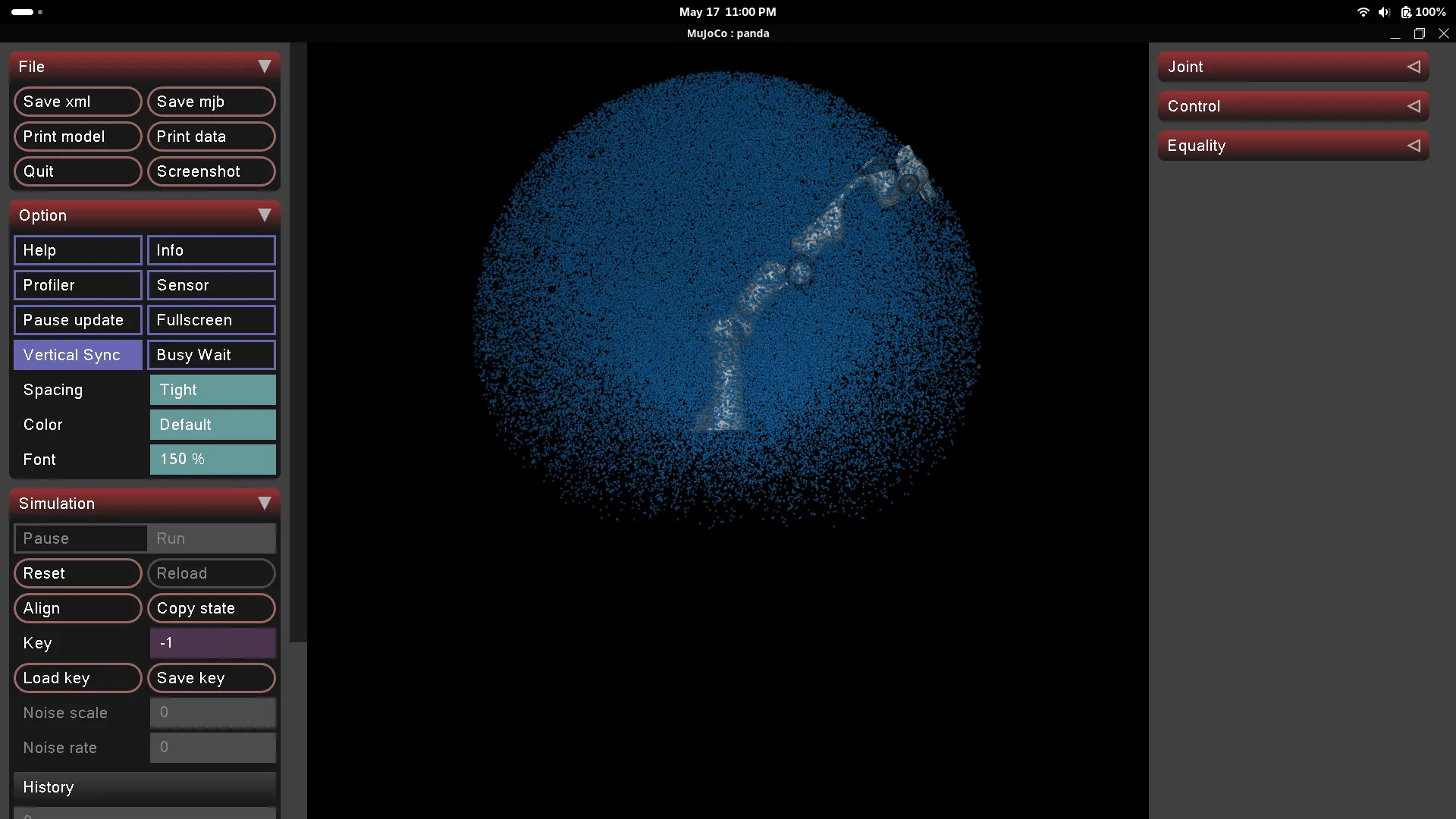
With these images, I notice that the arm’s reach hinges upon that first pitching joint from the base. The numbers in that code block above are deceptive because the arm pitches up from this joint. Recalculating from joint 2 as origin:
[from shoulder joint 2 anchor]
reach  min/mean/max : 0.066 / 0.611 / 0.858 m

max reach by cone (within ~45 deg):
  +x fwd  : 0.858 m   -x back : 0.858 m
  +y left : 0.858 m   -y right: 0.858 m
  +z up   : 0.858 m   -z down : 0.817 m
Brilliant! Maximum reach from joint 2 is ~0.858 m. This sets the bounds for randomly generated trajectories.
Requirements for trajectory.py:
- Generate smooth trajectories for the arm to follow.
- Support non-circular paths.
- Allow trajectories that extend beyond the 0.858 m radius.
- Quantify what fraction of the trajectory is within reach: discretise the path and check each point’s distance from the shoulder against 0.858 m.
Driving questions
- How can I improve the visualisation’s performance? (This will remain open even if I don’t write it.)
- How can I improve the visualisation’s aesthetics? (This will also remain open.)
- What trajectory shapes should I train on, and in what mix?
- How much does the initial curriculum choice affect learning later on?
- What is the minimum training run that tells me whether the RL setup is working?
Next
- Finish
trajectory.py: pick a simple trajectory now and leave a template for future types.